

As data center architectures continue to evolve toward higher efficiency and scalability, the Top-of-Rack (ToR) design has become a standard approach for server connectivity. By placing switches at the top of each rack, ToR architectures reduce cabling complexity, improve manageability, and enable predictable performance. Within this model, 10/25G SR dual-rate optical modules play a key role in delivering flexible, high-speed connections between switches and servers.
The Role of ToR in Modern Data Centers
In a ToR deployment, each rack is equipped with a dedicated access switch that connects directly to the servers within the same rack. These switches then aggregate traffic and forward it upstream to aggregation or spine layers. This design minimizes long cable runs and reduces the need for centralized patching, making it ideal for high-density environments.
Because ToR switches must support a wide range of server types and network speeds, flexibility at the optical layer becomes critical. This is where 10/25G SR modules provide a distinct advantage.
Flexible Server Connectivity
Modern data centers rarely operate at a single uniform speed. Many environments are in transition, with a mix of legacy 10G servers and newer 25G-enabled systems. Replacing all hardware at once is costly and often impractical, especially in large-scale deployments.
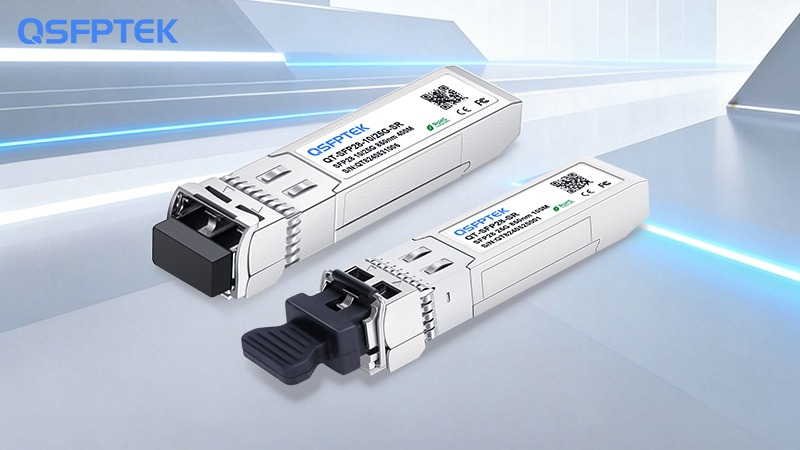
10/25G SR dual-rate modules allow ToR switches to support both 10G and 25G links using the same optical interface. This enables seamless connectivity to mixed server environments without requiring different types of transceivers. For example, a ToR switch can connect to older servers running at 10G while simultaneously supporting newer servers at 25G, all within the same rack.
This flexibility simplifies network design and supports gradual infrastructure upgrades, which is a common requirement in enterprise and cloud data centers.
Optimizing High-Density Cabling
One of the primary benefits of ToR architecture is improved cable management, and 10/25G SR modules further enhance this advantage. These modules typically operate over multimode fiber (MMF), such as OM3 or OM4, using LC duplex connectors. Compared to copper cables, fiber is lighter, thinner, and easier to route, which is essential in racks with high port density.
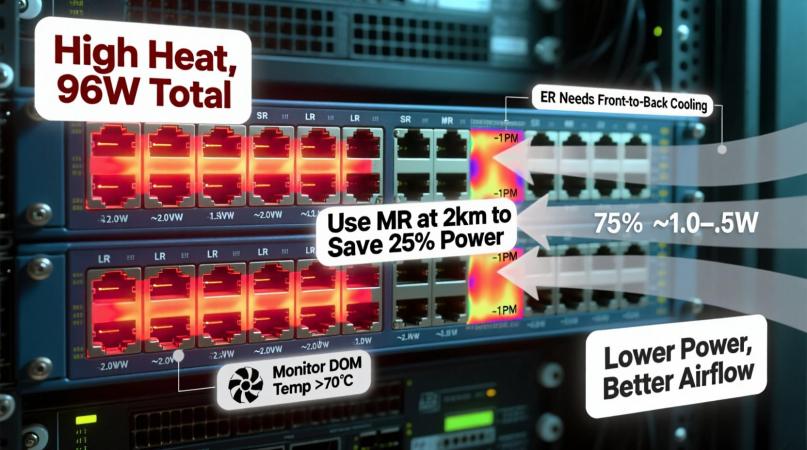
In high-density ToR deployments, dozens of servers may connect to a single switch. Using compact fiber patch cords with SR optics helps reduce cable congestion, improves airflow, and simplifies maintenance. This is particularly important in modern racks where thermal management is a key concern.
Additionally, the short-reach nature of SR optics aligns well with ToR design principles. Most connections are within the same rack or between adjacent racks, typically well within the supported distance of multimode fiber.
Cost and Operational Efficiency
From a cost perspective, 10/25G SR modules strike a balance between performance and affordability. Multimode fiber infrastructure is generally less expensive than single-mode solutions for short distances, and the dual-rate capability reduces the need to stock separate modules for different speeds.
Operationally, having a single type of module that supports both 10G and 25G simplifies inventory management and reduces the risk of deployment errors. Network teams can standardize on one transceiver type, making installation, replacement, and troubleshooting more straightforward.
Enabling Scalable Data Center Growth
As data center traffic continues to grow, ToR deployments must scale efficiently without introducing unnecessary complexity. 10/25G SR modules provide a practical path forward by supporting incremental upgrades and maintaining compatibility across different generations of hardware.
They are particularly valuable in environments where rack-level upgrades occur over time rather than all at once. By enabling mixed-speed operation and efficient cabling, these modules help ensure that ToR architectures remain adaptable and future-ready.
Conclusion
10/25G SR dual-rate modules are well-suited for Top-of-Rack deployments, where flexibility, density, and simplicity are essential. By supporting both legacy and next-generation server connections, optimizing cabling in dense racks, and reducing operational overhead, they play a critical role in modern data center design. For organizations looking to scale efficiently while managing costs, these modules offer a reliable and practical solution at the access layer.
