

Being able to turn it is not the same as being able to hold it
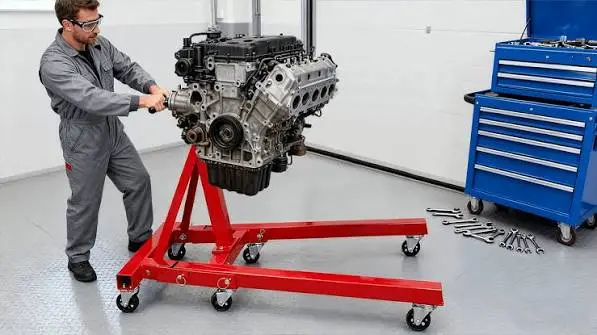
Canadian rebuild projects get started in late summer so the machine is ready before winter. An engine stand puts a block at working height and lets it turn to any angle, and the moment it turns unexpectedly is the moment most people discover what they got wrong.
The rotation on an engine stand is not powered or geared in any meaningful way. There is a handle and a locking pin, and between those two positions the block is free to go wherever gravity takes it, which is downward and quickly if it is hung badly.
How to balance an engine on a stand comes down to one line
Every object turns most easily about its center of mass, and it resists turning about anything else. Mount a block so that its center of mass sits well below the rotation axis and the assembly behaves like a pendulum, always wanting to swing back to the same position.
That pendulum is what pulls the handle out of somebody’s hand. A four hundred pound block hanging a hand’s width below the axis produces a turning moment large enough that letting go halfway through a rotation is genuinely dangerous.
The mounting plate should sit near the crankshaft, not near the bolt holes
On most engines the center of mass is close to the crankshaft centerline and slightly above it, because the block casting is heavier than the heads. Setting the plate so the rotation axis lands near that line is what makes the block turn with two fingers.
The rated figure assumes the load is where it should be
The rated figure is measured with the weight centered close to the head. Hang the same load further out on the arms and the leverage on the frame rises, so the real engine stand weight capacity at full extension is meaningfully lower than the number on the label.
Casters are for repositioning, not for moving a loaded stand across a shop
The casters under a 1000 pound rotating engine stand are fine on a smooth level slab and stop dead against a cord, a bolt, or an expansion joint. A tall load stopping suddenly at the bottom keeps going at the top, and the resulting tip is the most common way a block ends up on a workshop floor.
Stands divide by how the load is carried
•Rotating stand: full access, needs careful balance
•Fixed cradle: simple, no rotation at all
•Overhead hoist: for moving, never for working
Where a rotating stand earns its place and where it does not
•Strength: any face of the block at working height
•Strength: one person can do a two person job
•Limit: an unbalanced load fights the operator
•Limit: capacity falls as the arms extend
Weighed against working on a bench, a stand costs floor space and returns access to the pan rail and the deck without lifting anything twice. A rebuilder near Kingston sets the plate by trial before torquing it, turning the block by hand until it stops wanting to fall.
Home rebuilding keeps taking on work that used to be sent out
Owners increasingly strip and reassemble engines themselves and send out only the machining, which has moved shop grade fixtures into private garages and made the handling equipment around a rebuild as important as the tools used on it.
That shift is why the automotive equipment TMG Industrial supplies is specified around how a load is carried and controlled rather than around headline capacity alone.
