

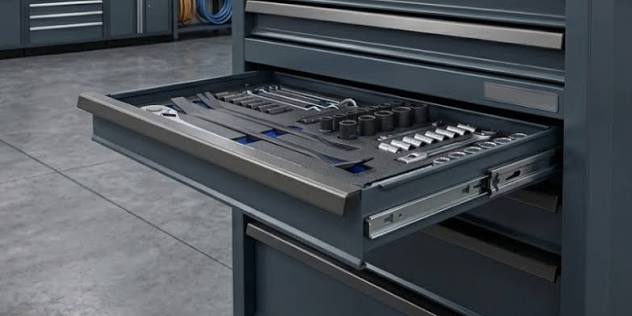
Industrial drawers are often expected to perform under conditions that ordinary household storage hardware cannot handle. Tool cabinets, mobile workshops, machinery compartments, transport equipment, and engineering storage systems may contain heavy contents and require repeated access throughout the working day.
The drawer slide is a critical component in these systems because it supports the drawer and controls its movement. Depending on the application, businesses may need a locking heavy duty drawer slide or a non-locking heavy duty drawer slide.
Start with the Application
The best drawer slide is determined by how the drawer will actually be used. A drawer installed inside a stationary workshop cabinet may have completely different requirements from one fitted to a mobile service vehicle.
Businesses should first identify the maximum combined weight of the drawer and its contents. They should then consider how often the drawer will be opened, how far it needs to extend, and whether the equipment will experience vibration or movement.
These details provide a useful foundation for selecting the correct slide capacity and configuration.
Benefits of Locking Mechanisms
A locking heavy duty drawer slide incorporates a mechanism designed to hold the drawer in a particular position. This feature can be especially useful in environments where equipment moves regularly.
For example, service vehicles and mobile workshops may travel over uneven roads. Without suitable drawer retention, heavy drawers can move or open unexpectedly. A locking mechanism can help provide additional control during transportation.
Locking slides may also be useful when operators need the drawer to remain securely extended while accessing tools or equipment, depending on the specific design.
Keeping Things Simple with Non-Locking Slides
Not every application requires a locking mechanism. A non-locking heavy duty drawer slide can be a practical choice for fixed installations where accidental drawer movement is unlikely.
These slides can provide smooth extension and retraction while keeping the drawer system straightforward. They can be suitable for industrial cabinets, workshops, storage units, and equipment enclosures that remain in a stable position.
For businesses that prioritise simple operation and frequent access, eliminating an unnecessary locking feature may also make everyday use more convenient.
Installation and Load Distribution
Correct installation is essential for achieving reliable performance from heavy-duty drawer slides. Slides should be mounted according to the manufacturer’s specifications, with appropriate alignment and clearance.
The load should also be distributed appropriately within the drawer. Concentrating excessive weight in one area can place additional stress on the slide mechanism.
Before installation, businesses should verify drawer dimensions, slide length, mounting requirements, and available clearance. These checks can prevent compatibility problems later.
Finding Suitable Industrial Components
When selecting drawer hardware, businesses can research suppliers such as Schutts Industrial for industrial-grade components and technical product information.
Supplier support can be particularly useful for projects involving custom equipment or unusual load requirements. Customers should provide details about the drawer’s weight, dimensions, operating environment, and intended use when seeking a suitable product.
Comparing specifications rather than simply choosing the cheapest option can help businesses achieve better long-term value.
Making an Informed Choice
Locking and non-locking slides each have their place in industrial storage design. A locking heavy duty drawer slide can provide additional control where movement and vibration are concerns, while a non-locking heavy duty drawer slide can be an effective solution for stable applications requiring straightforward drawer access.
The correct choice ultimately depends on load capacity, installation conditions, operating frequency, drawer movement, and the surrounding environment.
Businesses can improve the reliability of their storage systems by carefully assessing these requirements before purchasing. With appropriate product selection and support from suppliers such as Schutts Industrial, manufacturers and industrial operators can develop drawer systems designed to handle demanding everyday use.
