

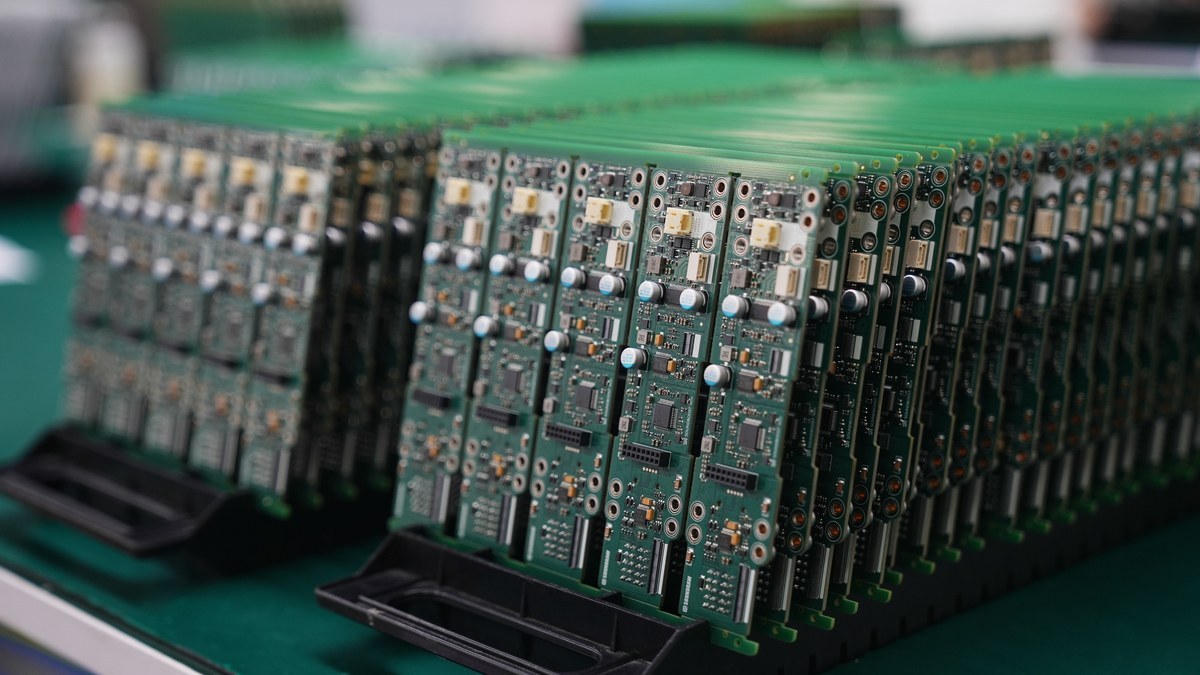
Custom PCB assembly is the process of building a printed circuit board that is designed for one specific product rather than a generic, off-the-shelf board. Every product has its own size limits, power needs, signal requirements, and operating environment, so a custom board is drawn around those exact demands. Engineers begin with a schematic that defines how each component connects, then turn that schematic into a physical layout with copper traces, pads, and mounting points. The result is a board that fits the enclosure, supports the required features, and avoids the wasted space and cost of a one-size-fits-all design.
The design stage is where most of the value in custom PCB assembly is created. Component placement is planned so that sensitive analogue circuits sit away from noisy power sections, high-speed signals take the shortest sensible paths, and heat-producing parts get room to breathe. Designers also think about manufacturing from the start, checking that trace widths, clearances, and hole sizes match what the assembly line can reliably produce. A careful design review at this stage catches errors that would be far more expensive to fix after boards have been fabricated and populated.
Prototyping is a natural companion to custom PCB assembly. A small first run lets engineers test the real hardware, measure performance, and discover problems that never appear in simulation. Prototypes reveal issues such as unexpected interference, connectors that are awkward to reach, or components that run hotter than predicted. Because the prototype uses the same assembly process as the final product, the lessons learned transfer directly into the production run, saving time and avoiding repeated revisions.
Surface mount technology dominates modern custom PCB assembly. Tiny resistors, capacitors, integrated circuits, and connectors are placed onto solder paste by fast, precise machines and then soldered in a reflow oven. This approach allows very dense layouts and small products, from wearable devices to compact industrial controllers. Through-hole parts are still used where strength matters, such as heavy connectors or components that face vibration, and a good assembly service handles both methods on the same board without difficulty.
Component sourcing is another critical part of custom PCB assembly. A board may need dozens or hundreds of distinct parts, and each one must be genuine, correctly specified, and available in the right quantity. Shortages, counterfeit parts, and last-minute substitutions are real risks, so experienced assemblers check availability early, buy from trusted suppliers, and flag any part that could delay the build. Customers can supply their own parts or let the assembler procure them, and either route needs clear documentation to avoid mistakes.
Assembly itself follows a disciplined sequence. Bare boards are inspected, solder paste is printed through a stencil, components are placed, and the board passes through reflow soldering. After that, any through-hole parts are fitted, the board is cleaned, and it moves to inspection. Automated optical inspection checks solder joints and placement, while X-ray inspection looks inside hidden joints such as those under ball grid array packages. This layered inspection catches defects before they become field failures.
Testing is what separates a finished board from a working product. A basic power-on test confirms the board starts correctly, while functional testing exercises its real features with test fixtures that mimic the end product. In-circuit testing can probe individual nets and catch manufacturing faults such as shorts or missing parts. For products used in demanding settings, burn-in or environmental testing adds confidence that the board will keep working across temperature swings, humidity, and long operating hours.
Design for manufacturing is a principle that runs through every good custom PCB assembly project. Small choices, such as keeping consistent component orientations, leaving test points accessible, and avoiding parts that are hard to source, make assembly faster and more reliable. When designers and assemblers communicate early, the board is easier to build, yields improve, and the final cost drops. The cheapest board to assemble is usually the one that was designed with assembly in mind.
Volume flexibility is one of the main reasons companies choose custom PCB assembly. A startup may need only fifty boards to validate a product, while an established manufacturer may need tens of thousands. A capable assembly partner handles both extremes, adjusting machine setup, inspection depth, and testing to suit the order size. Low-volume runs get the same care as large ones, because early units often become demonstration models, certification samples, or the first units shipped to paying customers.
Quality standards give customers confidence in a custom PCB assembly service. Industry standards define acceptable solder joints, cleanliness, and workmanship, and reputable assemblers build their processes around them. Certifications for quality management show that procedures are documented and followed, not improvised. Traceability matters too: knowing exactly which parts and materials went into each batch makes it possible to investigate any problem quickly and to prove compliance when a customer or regulator asks.
Cost in custom PCB assembly depends on several factors working together. Board size and layer count set the fabrication price, component count and complexity drive placement time, and testing depth adds labour and equipment cost. Ordering larger quantities spreads setup costs across more units, which is why prototypes cost more per board than production runs. Being open about these trade-offs helps customers choose the right balance between price, speed, and quality for their project.
Choosing the right assembly partner is a decision that affects the whole product. Good partners ask detailed questions, review designs honestly, and warn about risks before production begins. They offer clear lead times, transparent pricing, and regular updates while the build is underway. The best relationships last across many products, because the assembler learns the customer’s standards and the customer trusts the assembler’s judgement. That trust is earned one successful build at a time, and it is the real foundation of custom PCB assembly.
